
Sharpen Your Thinking - V.1
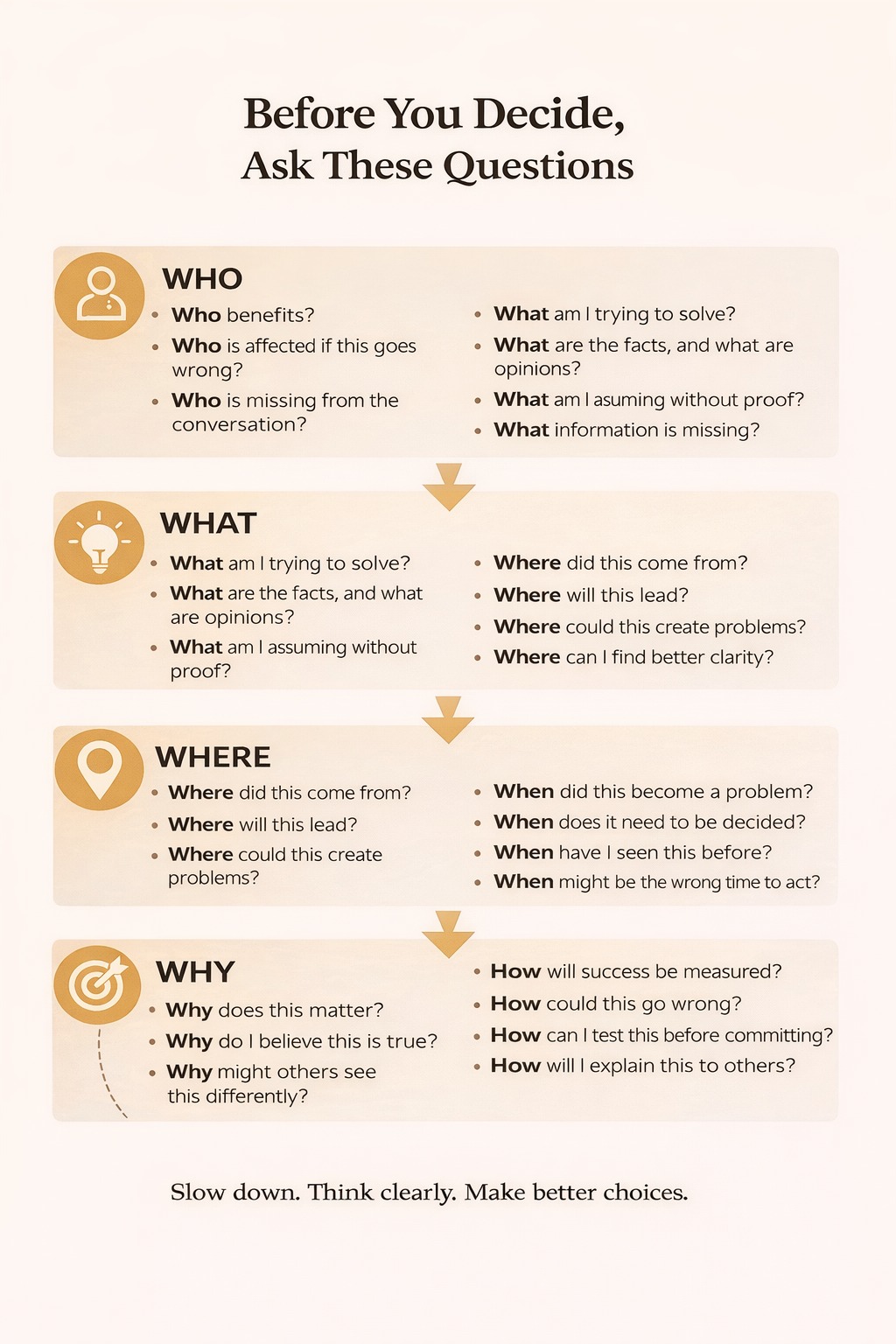
Before You Decide Anything, Ask These 6 Questions - (5W & 1H) Technique
We make hundreds of decisions every day. Some are small. Some quietly shape our careers, relationships, and future. But here’s the challenge: most poor decisions don’t happen because we lack intelligence. They happen because we didn’t pause long enough to ask better questions.
The powerful framework of questions is organised around six familiar words: Who, What, Where, When, Why, and How.
At first glance, it looks basic. In practice, it changes conversations.
Start With “Who” - 1
Every decision has a human footprint.
Instead of rushing toward a solution, pause and consider who actually benefits from this choice and, just as importantly, who might be affected if it fails. Think about who hasn’t been invited into the conversation yet. Often, the most valuable insight comes from the quietest voice in the room. And if the problem seems complex, ask yourself who has solved a similar problem before. Experience leaves clues.
When you expand the “who,” you expand the quality of thinking.
Clarify the “What” - 2
Many teams solve problems efficiently, but not always the right problems.
Before acting, step back and ask what you are really trying to fix. Strip away assumptions. Separate verified facts from opinions and interpretations. Notice where you might be filling information gaps with guesswork. Then ask yourself what is still missing.
Clarity at this stage prevents confusion later.
Explore “Where” - 3
Decisions rarely exist in isolation. They come from somewhere and lead somewhere.
Consider where this issue originated. Is it a process flaw, a communication gap, or a structural limitation? Then look ahead. Where could this decision take you? Could it create downstream challenges? If the picture still feels unclear, reflect on where you might find better data or a deeper understanding.
Context protects you from unintended consequences.
Examine “When” - 4
Timing is strategy.
Ask when this truly became a problem. Has it been building slowly? Does it require immediate action, or does it simply feel urgent? Reflect on when you’ve seen something similar before and what happened then. Also consider when acting might actually make things worse.
Right decisions made at the wrong time can still fail.
Dig Into “Why” - 5
This is where thinking matures.
Why does this matter? Why do you believe your current interpretation is correct? Why might someone else see the situation differently? And perhaps most revealing, why hasn’t this already been resolved?
“Why” exposes assumptions. It surfaces motives. It uncovers root causes.
Move Toward “How” - 6
Finally, shift from reflection to execution.
Think about how success will be measured. Define what progress actually looks like. Anticipate how the plan could go wrong before it does. Consider how you might test the idea on a smaller scale. And be ready to explain your reasoning clearly to others.
Good thinking earns trust when it is communicated well.
This framework works because it slows us down just enough to think deliberately. It creates structure without complexity. It turns ordinary conversations into thoughtful ones.
In a world that rewards speed, a thoughtful pause is powerful.
Before your next important decision, take a moment and walk through these six anchors.
Which one do you instinctively skip when you’re under pressure?
Conclusion:
The 5W & 1H framework transforms accreditation from a compliance exercise into a thinking discipline. Whether it is JCI, NABH, or NABL — quality begins with the right questions. Ask them consistently, answer them honestly, and excellence becomes not an event you prepare for, but a culture you live every day.
Read Our Next Article on: 5 Wand 1 H which impacts Healthcare on Day to Day Operations
Compiled by: RAGA ✍

Comments (0)
No comments yet. Be the first to comment!